Building an AI-Pilled Company
I’ve always wanted to work on things that feel like science fiction. That pull took me into technology and entrepreneurship long before startups looked sensible. I spent my teenage years in chat rooms and in front of computers, hacking and building things.
Curacel’s journey with AI didn’t begin with ChatGPT.
Over five years ago, before the current wave, I started Curacel as an AI company. We were already building and selling AI solutions to insurance companies.

It was hard, especially in emerging markets and without much capital. We couldn’t train every model we wanted. We built data science teams and shut some down when we realised we lacked the right expertise. Good data was scarce. We still found ways to build our solutions despite those constraints, but there were real limits.
The clean version of an AI transformation story is usually false. A company discovers AI, buys everyone a licence, runs a workshop, produces a few demos and announces that it is now AI-first. That’s not how it worked for us.
We had wrestled with the hard parts for years. We had tried to hire the expertise, dealt with missing data, and lived the gap between a promising model and a reliable product. That history prepared us for the moment the tools became far more capable and accessible.
It also explains why I don’t fault founders who struggle to make AI adoption feel natural inside their companies. When friends tell me it feels inorganic, I grok it. I now spend my time around people who are similarly obsessed, and that can distort your sense of how normal any of this is.
So Curacel did not suddenly become an AI company. AI was already part of our identity. But identity, it turns out, is only the beginning.
Identity is not adoption
When companies started talking about becoming AI-first, the idea resonated immediately. We already built AI for customers; operating this way internally should have been natural.
So I did what many founders did. I talked about it constantly. For weeks and months I encouraged people to use AI. We paid for ChatGPT, Replit, Gamma, Claude, Cursor, Grok and Gemini, giving people access to virtually every serious model and tool we thought could be useful. If somebody needed a capable tool, they could get it. We had removed the most obvious excuse.
It helped. It didn’t produce the change we wanted.
Access is not adoption, and a subscription is not a new operating model. Some people explore a new tool without being asked. Some use it once, get a mediocre answer and quietly return to their old workflow. Some use it for trivial tasks while the important work stays untouched. Others wait until the company defines what good usage actually looks like.
We had supplied tools and encouragement, but the expected behaviour was still vague. We needed to turn an ambition into a system.
Our identity made AI adoption easier. Turning it into an operating system made it useful.
The manifesto gave the ambition a shape
Curacel aspires to be a systems-driven company. We’re not perfectly systematic. No real company is. But we prefer processes and structure over hoping that important things happen by osmosis. I spend a slightly obsessive amount of time building those systems.
So I wrote an AI manifesto.
The manifesto made the direction explicit: why this mattered, what kind of company we intended to become, and what we expected to change. That gave us shared language and put the company in motion.
But a declaration doesn’t change how a company operates. Culture is what people do on a Tuesday, what leads expect, what gets rewarded, what gets measured, what somebody believes they own when they open their laptop. If we wanted AI in Curacel’s operating culture, we had to define competency through behaviour.
”Uses ChatGPT” was not a competency
We created an AI competency framework and kept iterating on it.
See Curacel’s AI competency framework
The standard was never that everybody should occasionally use ChatGPT. That bar is too low to mean anything. We wanted people to acquire the ability to redesign their own work.
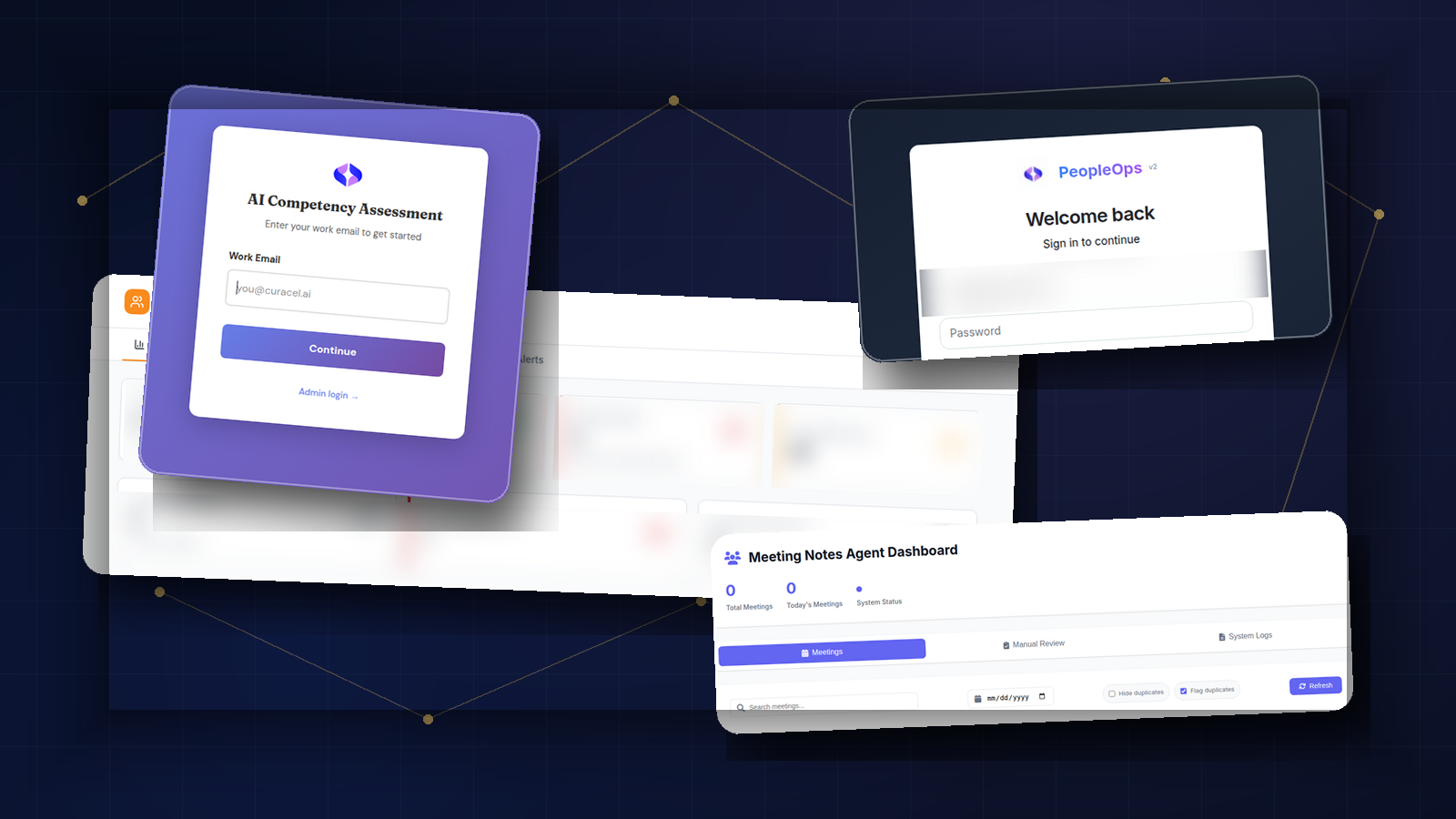
The baseline expectation became concrete. Every person should be able to vibe-code an internal tool for their own work or their team’s, and build automations with tools such as n8n.
That is a very different expectation from asking people to become better prompt writers. Prompting helps you complete a task inside a chat window. Building gives you something you can reuse. A finance team shouldn’t wait indefinitely for engineering capacity before testing a better repetitive workflow. A sales team shouldn’t always begin with a long product requirements document. If somebody can explain a problem clearly, they can increasingly build the first useful version of a solution.
This didn’t mean pretending everyone had become a software engineer, and it didn’t mean dropping security, quality or engineering standards. It meant shrinking the distance between the person who understands a problem and a working tool that helps solve it.
The framework made the expectation visible. Team leads could coach against it. Teams could compare notes. People who were ahead could pull others along. AI stopped being a vague interest and became part of what competence at Curacel meant.
Infrastructure matters more than enthusiasm
Telling people to build is easy. Making it practical is the actual work.
We self-hosted n8n and gave teams an internal domain to ship their tools. Now a useful prototype didn’t have to die on someone’s laptop.
The path still needed sensible controls. Internal tools can create security, privacy, reliability and maintenance problems if every prototype is treated as production software. Those are design constraints, not reasons to force every idea through the process built for customer-facing core systems.
The goal was to make the safe path the easy path. That meant giving people models, automation tools and somewhere to put what they build, defining the standards, and making the useful work visible. This was not one announcement or one quarter’s initiative. It was a long process of removing friction between an idea and a working internal tool.
Somebody has to be unreasonably committed
For years I signed my emails with Chief AI Evangelist. In practice, it described one of my actual jobs. I’m still one of the most psychotically AI-pilled people I know.
Alongside the strategic, sales, product and tactical work of being a founder, I pushed Curacel to understand what had become possible and what was about to become possible. I tend to live six to twelve months in the future on these things. That helps when it makes the company move early. It helps less when I assume everybody spent the weekend obsessing over the same release notes. They haven’t, and probably shouldn’t have to.
We needed a mechanism that could translate obsession into operational progress.
That became AI Operations.
AI Operations turned evangelism into execution
We formed a team inside Curacel called AI Operations. We looked for very smart, technical, hungry and highly competent people who were themselves AI-pilled.
Their job was to work out what should happen next and turn it into impact across the company. That meant helping teams identify opportunities, build tools and automate workflows, while helping those teams develop the capability to do more of it themselves.
In practice, AI Operations works as our team of Fully Deployed Engineers (FDEs). They embed within teams and work beside domain experts. They learn the workflows, build the tools and ship changes with the team, rather than from a central queue.
The people closest to a workflow usually understand its problems best, but a completely decentralised approach produces duplicated work, inconsistent standards and disconnected experiments. A central team can provide infrastructure, reusable components, support and quality control. What it shouldn’t become is the queue every idea has to pass through.
The pattern is showing up elsewhere too. Uber’s recent Agentic Pods are a useful example: roughly 30 AI-proficient engineers paired with business-domain experts in two-week pods. They shadow workflows, prioritise opportunities, then build, validate and ship agents. The specific implementation will differ by company. The idea that travels is capable builders sitting beside domain experts and shipping with them.
AI Operations also gave my own energy somewhere to go. Founder energy is useful. Founder energy without structure is mostly a lot of messages.
Internal tools became visible proof
By the end of last year and the beginning of this one, the work was producing tangible results. Engineering, finance and sales were all building and using their own tools.
The outcomes went beyond the tools themselves. These numbers come from our internal end-of-2025 company report:
- Human-handled support and customer-success tickets fell 80% after we deployed SupportAI.
- Recruitment communication became 90% automated.
- Finance reporting time fell 60%.
- Product sprint planning went from 48 hours to about two.
- Meeting notes straight into CRM and Slack summaries: an estimated 600–1,000 hours saved across the company every year.
These artefacts changed the conversation inside the company. A manifesto can sound theoretical. A competency framework can feel administrative. A useful tool built by a colleague is harder to dismiss. It creates a local example: this person understood a problem, built something and changed how the work gets done. Others see it, use it, improve it, and start recognising similar opportunities in their own teams.
That’s how a capability becomes cultural: the behaviour is normal and the evidence is sitting in front of people.
Some internal tools became products
Some of what came out of the wave of internal innovation became products we could offer customers.
SupportAI is the clearest example. It grew into an agentic system designed to handle customer-support work.
Internal adoption and product development aren’t separate worlds. When teams build with models, automate workflows and deploy tools, the company accumulates practical knowledge. It learns where models fail, where human review matters, what needs monitoring, and what looks impressive in a demo but collapses in real use. That knowledge feeds the product, and product problems sharpen the internal standard in return.
Not every internal experiment worked or became a product. Many were never supposed to. Some solved one narrow problem. Some were replaced. Some taught us what not to build. The value wasn’t only in the surviving artefacts; it was in building the institutional muscle to move from a problem to a tested system.
What it actually took
Curacel didn’t become AI-pilled because we bought everyone ChatGPT.
The change required several things working together:
- An identity that made the direction credible
- Leadership willing to champion it repeatedly
- Access to capable models and tools
- A manifesto that made the ambition explicit
- A competency framework that defined expected behaviour
- Training, coaching and support for people building new skills
- Infrastructure that made internal tools practical to deploy
- AI Operations, with embedded FDEs converting exploration into execution beside domain experts
- Visible examples from engineering, finance, sales and other teams
- Metrics that separated genuine adoption from theatre
- Product pathways that turned some internal capabilities into customer value
Buying the tools was never enough. If people don’t know what good looks like, usage is random. If they have nowhere to ship, nothing leaves their laptop. Without standards, you get a mess. If nobody measures the outcome, the manifesto becomes wall art.
Each part has to support the next, and somebody has to keep driving it.
For me, that is what being AI-pilled means. The company actually changes how it works. You can see it in the output, not a deck.
Our frontier today is agent systems that do work. We’re deep in human-agent collaboration: Excellers (Curacel employees) use OpenClaw and Hermes Agents.
If you wanna follow my more realtime thoughts on AI and agents, I share a ton on my X even though it might be more technical.
And we are always looking for AI-pilled folks. If that’s you, reply or send me a note.
Dictated by Henry. Written and Narrated by SuperAda.